
Have you ever stood in front of the tool aisle, hesitating between a heat gun and a hot glue gun — they both look similar, but which one do you actually need?
Don't worry. This article will clear it up for you once and for all. Despite both having "hot" in their names, their uses are worlds apart. Pick the right one and you've got a powerful tool; pick the wrong one and you've just wasted your money.
The Core Difference in One Sentence
Heat gun = blows hot air (directed at objects to heat, deform, shrink, or strip them)
Hot glue gun = dispenses hot glue (melts glue sticks and squeezes out adhesive to bond things together)
In short: A heat gun is a "heating tool," while a hot glue gun is a "bonding tool."
1. What Does a Heat Gun Do?
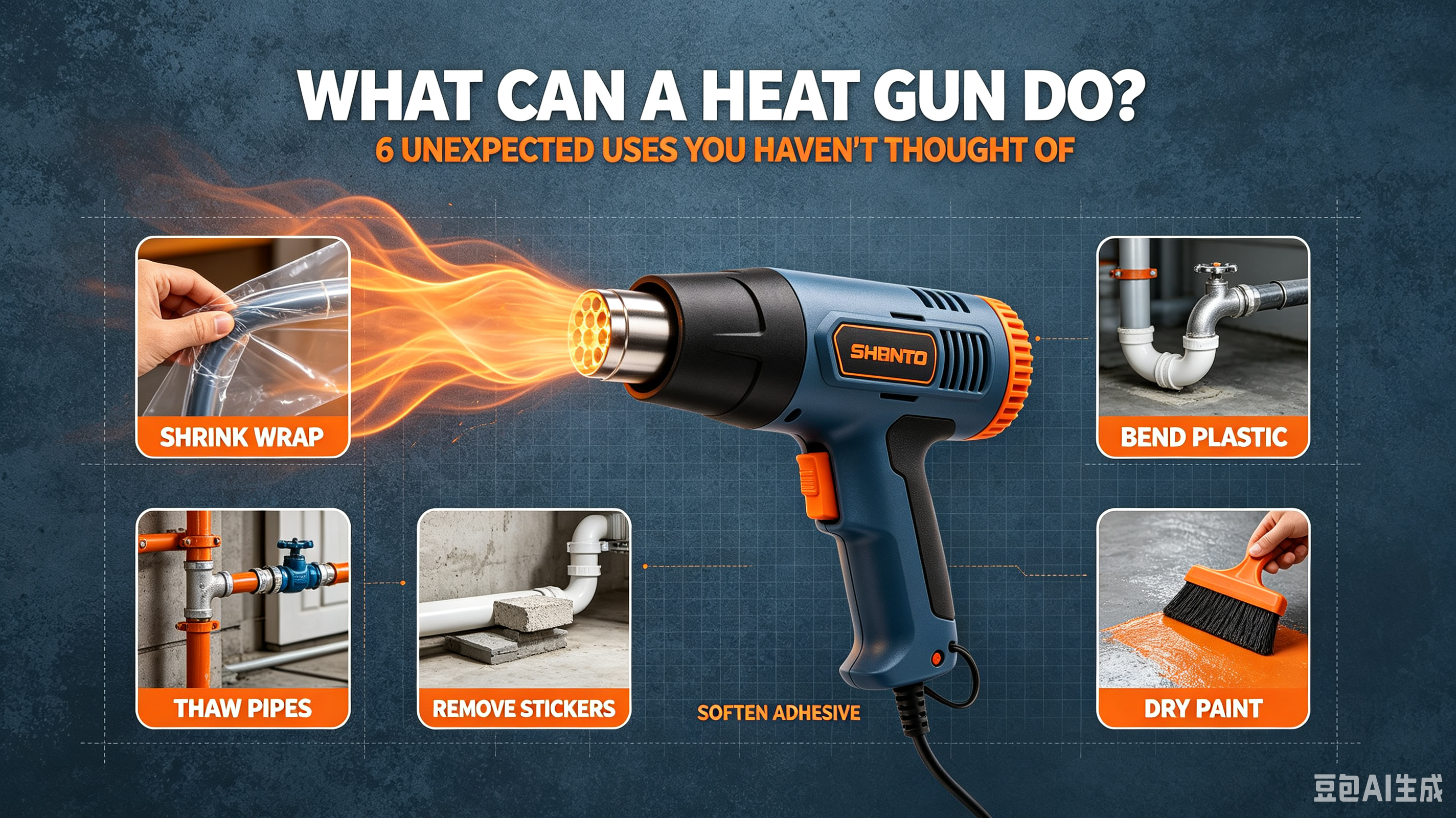
A heat gun emits a stream of high-temperature air, using heat and airflow to alter the state of objects. It doesn't bond things — it achieves effects through heating.
Main Applications:
-
Heat-shrink tubing: Slide a heat-shrink tube over a wire joint, apply heat, and it tightly conforms to insulate and protect the connection
-
Paint and adhesive removal: High heat softens old paint or stubborn glue, making them easy to scrape off
-
Defrosting and de-icing: Quickly thaws frozen outdoor equipment in winter
-
Automotive film installation: Shrinks and shapes PPF or color-change vinyl during application
-
Bending and shaping: Heats PVC pipes or acrylic sheets so they can be bent into desired forms
-
Desoldering circuit board components: Professional desoldering stations (around 700W) can melt solder paste under SMD chips
Key Heat Gun Specifications:
| Parameter | Description | Best For |
|---|---|---|
| Power | 300W mini models / 2000W industrial units | 300W is sufficient for most household use; choose higher wattage for heavy-duty work |
| Temperature Range | Typically 200-600°C adjustable | Medium-low heat for shrink tubing; high heat for paint stripping |
| Airflow Control | High/Low speed settings | Low airflow for delicate tasks to avoid blowing away tiny components |
⚠️ Important Warning: Never use a 2000W industrial heat gun on a computer motherboard! The powerful airflow can blow away miniature resistors, and the extreme heat can warp the board.
2. What Does a Hot Glue Gun Do?
A hot glue gun melts solid glue sticks and dispenses the molten adhesive. Its core purpose is to answer the question: how do I quickly and securely stick things together?
Main Applications:
-
Crafts and model making: Bonds fabric, wood, plastic, dried flowers, and more
-
Home repairs: Fixes loose items and seals gaps
-
Securing cables on circuit boards: Applies hot glue to prevent wires from loosening or detaching
-
Woodworking tacking: Acts as a "third hand" for temporary positioning before screwing or nailing
-
Filling gaps: High-viscosity hot glue can fill irregular gaps
Key Hot Glue Gun Specifications:
| Parameter | Description | Buying Advice |
|---|---|---|
| Temperature Type | Low-temp (~120°C) / High-temp (~190°C) | Low-temp for fabric/foam; high-temp for wood/plastic (stronger bond) |
| Power | 20-100W | Higher wattage = faster warm-up; choose high wattage for professional use |
| Flow Rate | 5-30g/min | High flow rate for large-area bonding to prevent glue from drying before reaching the end |
| Glue Stick Diameter | 7mm / 11mm | 7mm for precision work; 11mm for heavy-duty projects |
Limitations of Hot Glue Guns:
-
Does not bond well with glass, steel, or smooth plastics — adhesion is weak
-
Not suitable for Styrofoam/polystyrene foam, as high heat will melt it directly
-
Not ideal for high-temperature environments — the glue will soften again
-
The adhesive cools quickly, so you need to work fast
3. Comparison Table — At a Glance
| Aspect | Heat Gun 🔥 | Hot Glue Gun 🧴 |
|---|---|---|
| Core Function | Heating, shrinking, stripping | Bonding, fixing, filling |
| How It Works | Blows hot air to heat objects | Melts glue sticks and dispenses adhesive |
| Typical Uses | Shrink tubing, paint removal, film installation, desoldering | Crafts, DIY, repairs, cable securing |
| Consumables | None (electric only) | Glue sticks (7mm or 11mm) |
| Temperature Range | 200-600°C | 120-190°C |
| Best Buy Advice | A 300W mini model covers 99% of household needs | Low-temp for crafts; high-temp for stronger bonds |
| Approximate Price | $20-$100+ | $10-$50+ |
4. Two Common Misconceptions
Misconception #1: "Can a heat gun replace a hot glue gun?"
No. A heat gun only blows hot air — it doesn't dispense glue. If you try to melt a glue stick with a heat gun and drip it onto an object, you'll end up with the glue stick flying away, the surrounding area overheating, and absolutely zero precision placement of adhesive.
Misconception #2: "Can I use a hot glue gun to desolder circuit boards?"
Absolutely not. A typical hot glue gun is only 20-100W and reaches just over 100°C — nowhere near hot enough to melt lead-free solder (which requires 300°C+). Forcing it on a motherboard will only "cook" the surrounding components and ruin the board.
5. Final Buying Recommendations
If what you need to do is "bond" — go with a hot glue gun.
For crafts, DIY, and general repairs, a hot glue gun costs just a few bucks and gets the job done.
If what you need to do is "heat" — go with a heat gun.
For shrink tubing, paint stripping, desoldering, or film installation, a 300W mini heat gun is more than enough for household use.
If your budget allows, get both.
They each have their strengths and don't conflict with each other in your toolbox. The heat gun handles "heating" jobs, while the hot glue gun takes care of "bonding" tasks. Together, they cover most of your crafting and repair needs.
One final reminder: whichever one you use, be careful — they get dangerously hot! The metal nozzle of a heat gun and the molten glue from a glue gun can both cause severe burns. Always store them safely after use.