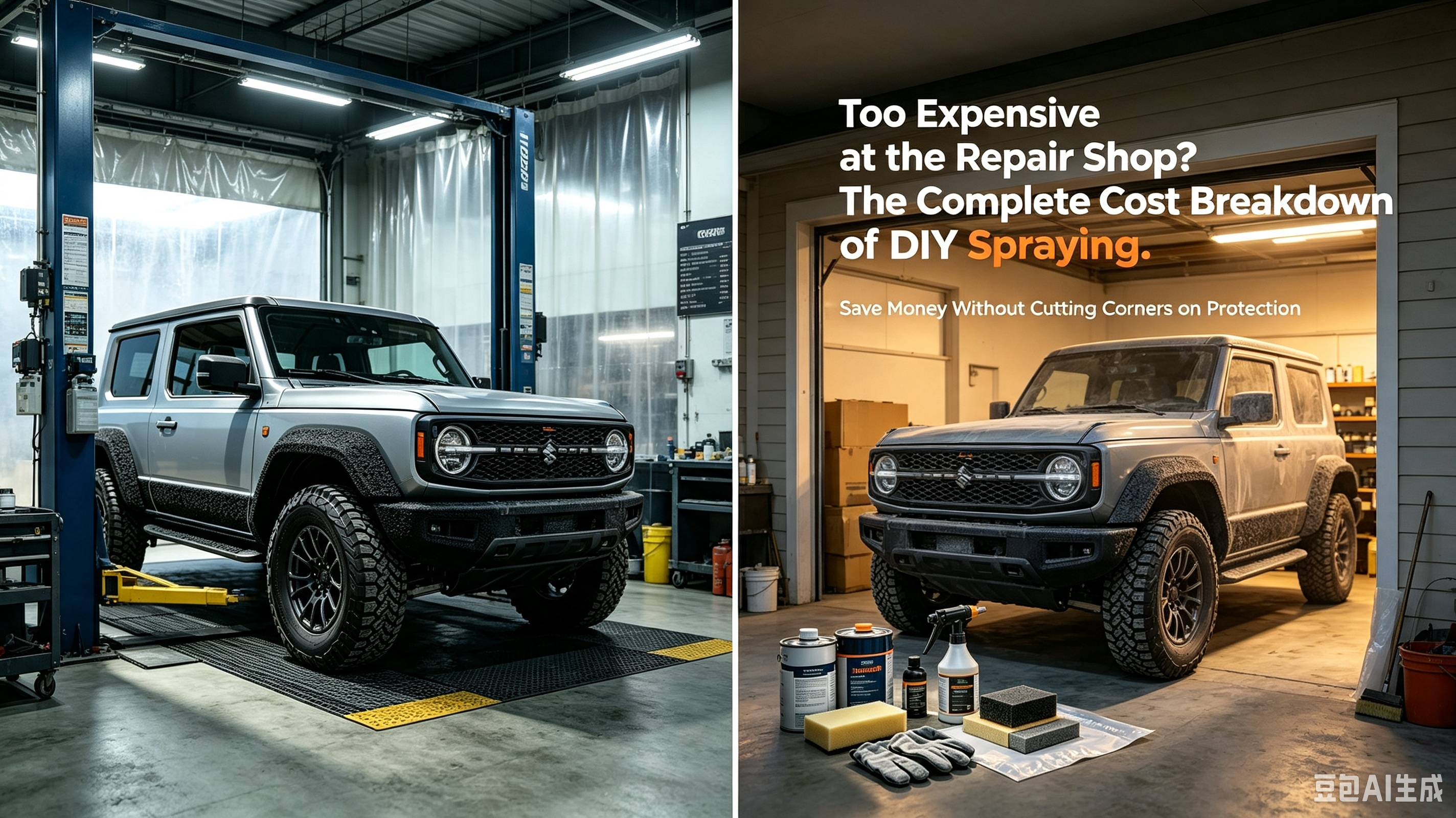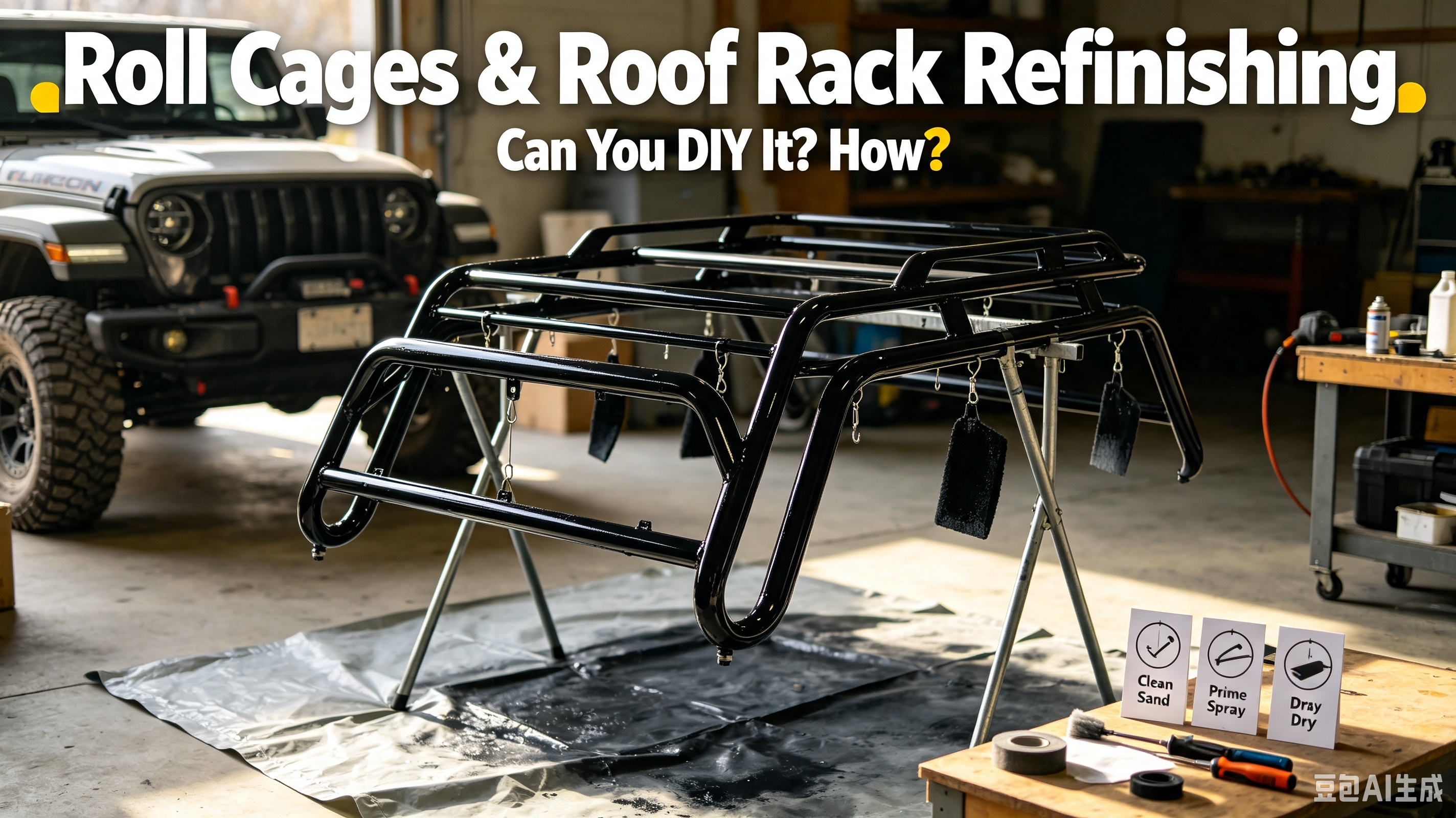

There's a very common phenomenon in the off-road community: you get a scratch on the body, a ding on the bumper, a bit of peeling paint on the roll cage, and your first thought is — "I'll just grab a spray can from the hardware store and touch it up."
To be honest, I've done it too. And after the first time, I was pretty pleased with myself: cost me just a few bucks, the color looked close enough, saved a few hundred bucks compared to going to a shop. Felt like a win.
But that "win" feeling pretty much disappeared within three to six months. Either it peeled, or it faded, or rust came creeping back from underneath.
Today I want to talk about: why don't we recommend using spray cans for off-road touch-ups? This isn't me trying to sell you expensive stuff — it's me sharing some hard truths after having made these mistakes myself.
1. First Thing: What Exactly Is in That Spray Can?
Most people don't know that spray paints on the market fall into two main categories:
| Type | Composition | Use Case | Price |
|---|---|---|---|
| General industrial spray paint | Nitrocellulose or alkyd resin | Iron railings, security grilles, industrial equipment | $1-2/can |
| Auto-specific touch-up spray cans | Acrylic or polyurethane (some with clear coat) | Auto body spot repairs | $6-15/can |
| Professional automotive paint (spray gun) | 2K polyurethane (requires hardener) | Full resprays, professional refinishing | Priced by mix — higher material cost |
Here's the key point: the vast majority of those $1-2 spray cans from the hardware store are industrial paint, not automotive paint.
These paints are designed for spraying iron gates, racks, and pipes. They don't take UV aging into account. They don't consider stone chips. They don't factor in temperature fluctuations — all of which are things your off-roader deals with every single day.
Using industrial paint on your off-road rig is like sending a soldier into battle wearing a business suit.
2. What Happens When You Use Industrial Spray Paint ($1-2) on Your Off-Road Rig?
① Poor Weather Resistance: Fading in Three Months Is Not an Exaggeration
Industrial paints use resin systems that age much faster than automotive paints.
A few months of UV exposure and you'll see noticeable fading or yellowing. Black turns gray. White turns yellow. Red turns into a dirty pink. If your rig sits outdoors most of the time, this happens even faster.
It looks "close enough" when you spray it. Six months later, the color mismatch is so bad even you can't stand it.
② Poor Adhesion: Peeling Is Just a Matter of Time
Industrial spray paint adhesion is designed for bare steel pipes, not automotive sheet metal (especially after it's been phosphated or E-coated).
Your roll cage and roof rack are constantly subjected to vibration, flexing, and stone impacts. Industrial paint simply can't hold up under these conditions. First a small chip, then it lifts, then bigger sections peel off completely.
③ Not Hard Enough: A Single Stone Chip Leaves a Scar
Automotive paints typically have a pencil hardness of 2H-3H, with some flexibility to absorb minor impacts.
Industrial spray paints are either too soft (stone chips leave white marks easily) or too brittle (chunks flake off when hit). Anyone who's done any off-roading knows that gravel is the #1 enemy of your paint — using soft paint to fend off stones is basically gambling.
④ No Real Rust Protection
A lot of people think "painting it means it won't rust." That's not quite how it works.
Rust prevention comes from the primer, not the topcoat. Most industrial spray paints skip the primer entirely — they're just color coats. The surface looks covered, but moisture can still seep in through microscopic pores and create a micro-galvanic effect underneath the metal surface. The rust grows from the inside out.
This is exactly why many self-sprayed roll cages develop little bubbles under the paint after six months — pop one open and it's full of rust powder underneath.
3. Are Those "Auto Touch-Up" Spray Cans ($6-15) Any Better?
Better, but they still have their limitations.
These use better paint formulations — closer to actual automotive refinish paints, and some even come with a clear coat. But they have another fundamental problem: the curing mechanism isn't right.
Professional automotive paints are 2K (two-component) — paint + hardener, which cure through a chemical reaction, resulting in a dense, hard film.
Spray can paints (including the expensive ones) are almost exclusively 1K (single-component) — they dry by solvent evaporation, forming a physical film that's significantly less dense.
Think of it like the difference between quick-dry glue and two-part epoxy. One is just "dry." The other is "cured." Dry things can be redissolved by solvents; cured things are truly stable.
In addition, professional spray guns use compressed air to atomize paint into extremely fine particles, while spray cans rely on internal pressure — the atomization is coarser, and the finish and gloss are noticeably different. The average car owner might not notice, but in a professional setting, the contrast is obvious.
4. The Off-Road Factor: Why These Flaws Are Magnified on Your Rig
A city car might go years without ever taking a stone impact. But an off-roader? Different story.
One trip on gravel roads and your chassis, wheel arches, side steps, and roof rack are all getting pelted. Under these conditions, industrial spray paint has a lifespan measured in months, not years.
One fellow off-roader said something that stuck with me:
"I touched up my front bumper with spray paint and thought I saved some money. Then I did a trip out west, and when I came back, the spots I'd touched up looked worse than before — the paint was chipped, the edges were lifting, and to redo it properly I had to spend two hours sanding all that messy old paint off first."
Saved $20, wasted 3 hours of work, and ruined my mood in the process.
5. So What's the Right Approach?
I'm not saying you have to spend a fortune at a shop. Here are some realistic options:
| Option | Best For | Pros | Cons |
|---|---|---|---|
| Go to a professional shop | People who want quality results without the hassle | Durable, great finish, stress-free | More expensive |
| DIY with proper automotive paint + spray gun (needs compressor) | Experienced DIYers with equipment | Professional-level results, cheaper than a shop | Equipment investment, steep learning curve — not for one-offs |
| Custom-mixed automotive spray can | DIYers who want convenience | Better than industrial paint, convenient | Still less durable than 2K professional paint — more of a temporary fix |
| Replace the part | Severe rust or structural damage | Permanent solution, safer | Most expensive |
My personal recommendation:
-
For roll cages, roof racks and other high-stress, high-vibration parts — either go to a shop or replace them. Don't cheap out here, because once the paint on these parts fails, rust and structural concerns follow.
-
For less critical cosmetic parts (like mirror caps, trim pieces), a custom-mixed auto spray can is an okay compromise — just accept that it won't last forever.
-
Never use $1-2 hardware store industrial spray paint on your off-road rig. This isn't about saving money — it's about wasting your time.
6. If You Absolutely Must DIY, This Is the Only Spray Can Setup I'd Recommend
Not all spray cans are created equal. If you really want to do it yourself and don't want to half-ass it with industrial paint, here's what I suggest:
-
Go to a professional automotive paint supplier (many on online marketplaces) and give them your vehicle's paint code
-
Ask them to mix a 2K acrylic spray can — this is real automotive refinish paint, with a dedicated clear coat layer
-
It'll cost about $15-30 — much more than a hardware store can, but you're paying for the paint itself, not the convenience
-
When spraying, strictly follow the full process: rust removal → epoxy primer → color coat → clear coat (don't skip any steps)
With this approach, you can achieve about 70-80% of the quality of a professional spray gun job. For a DIY project, that's a solid result.
Final Thoughts
I didn't write this to convince you to spend more money.
Quite the opposite — I want to help you avoid wasting money, avoid frustration, and avoid learning the hard way.
If you'd known upfront that a spray can touch-up wouldn't last six months, you probably wouldn't have wasted that time. If you'd known that saving a few bucks would mean spending twice as much time fixing it later, you might have made a different choice.
When it comes to off-road touch-ups, the cheap option is often the most expensive one — expensive in terms of time, in terms of frustration, and in terms of rework.
Either do it right, or accept that it's not perfect and leave it alone. The worst outcome is spending time and money and ending up with a result that looks worse than if you'd done nothing at all.
Hope this helps you avoid at least one pitfall.
— Someone who's spent more than their share of time and money learning this lesson