Do you have a beloved piece of old furniture that you can't bear to throw away, yet watch it become increasingly worn day by day? Do you want to change the color of your wardrobe or wooden door at home, but worry about the brush marks and poor finish left by a paintbrush?
If you're facing these troubles, then a suitable spray gun is the magic wand that will give your old furniture a new lease on life.
But, faced with the dazzling array of spray gun types on the market – pneumatic, electric, gravity-feed, siphon-feed – how do you choose? Don't worry, this guide will thoroughly explain the logic behind choosing a spray gun for furniture refinishing, helping you spend the least amount of money to achieve the most professional results.
1. Why Do You Need a Spray Gun? (Instead of a Brush)
Before diving into the selection, let's clarify one question: Why is a spray gun better than a brush for furniture refinishing?
| Comparison Dimension | Brush/Roller | Spray Gun |
|---|---|---|
| Surface Finish | Prone to brush marks, orange peel, bubbles | Smooth and flat paint film, achieving factory-quality finish |
| Application Efficiency | Slow, requires frequent dipping for large areas | Fast, covering area 5-10 times faster than a brush |
| Edge & Corner Treatment | Difficult to reach carvings, hollows, and gaps | 360-degree seamless coverage |
| Paint Utilization | Average, prone to dripping and waste | Gravity-feed can achieve over 95%, saving paint |
Simply put: A brush "smears it on," a spray gun "mists it on." For quality-focused furniture refinishing, a spray gun is the only correct choice.
2. Choosing the Right Type: Which of These 3 Spray Guns Suits You Best?
There are three main types commonly used for furniture refinishing. You can choose based on your budget and usage scenario.
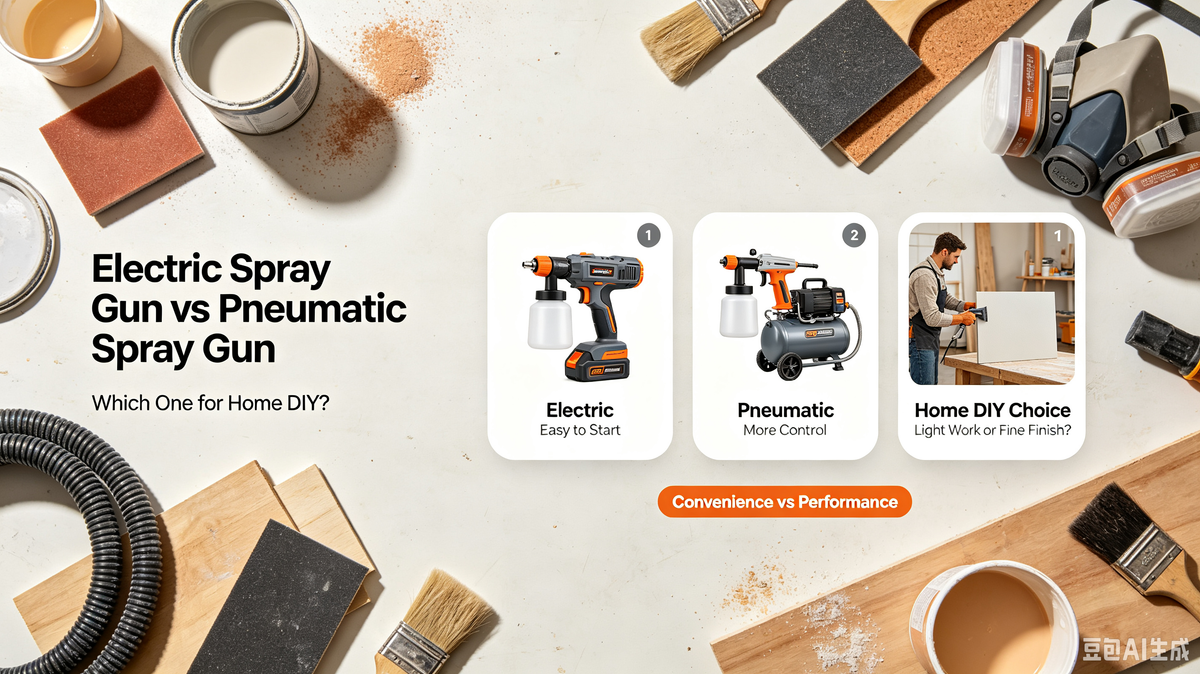
1. Electric Handheld Spray Gun (Lazy/Novice First Choice)
This is currently the most suitable type for home DIY beginners. No bulky air compressor is needed; it works by plugging into an outlet or using a lithium battery.
-
Advantages: Very easy to learn, plug-and-play, easy to store, affordable (usually $15-$50).
-
Disadvantages: Atomization fineness is slightly inferior to professional pneumatic guns, the body has some weight, which can be tiring during prolonged use.
-
Suitable for: Small-space furniture refinishing, occasional DIY, friends who don't want to deal with an air compressor.
-
Typical Scenario: Repainting a dining chair, spraying a nightstand.
2. Pneumatic Spray Gun (Advanced/Quality First Choice)
This is the mainstream choice for woodworking shops and furniture factories, requiring an air compressor.
-
Advantages: Excellent atomization effect, achieving a "mirror-like" smooth finish, lightweight body, flexible control.
-
Disadvantages: Requires additional investment in an air compressor ($80-$250), takes up space, noisy, requires some setup skill.
-
Suitable for: Those with extreme demands for paint finish, those who already own an air compressor, or those with large-scale refinishing plans (e.g., entire wardrobe doors).
-
Typical Scenario: Refinishing solid wood wardrobes, spraying high-gloss piano finishes.
3. Airless Spray Gun (King of Efficiency)
This type of gun uses extremely high pressure to atomize the paint directly, requiring no compressed air.
-
Advantages: Highest efficiency, suitable for very large walls, ceilings, fences.
-
Disadvantages: Expensive equipment, significant paint overspray, wastes a lot of paint, not suitable for fine furniture work.
-
Suitable for: Refinishing outdoor wooden fences, large-scale wall color changes.
-
Recommendation: Not recommended for furniture refinishing unless you are repainting the entire exterior wall of your house.
3. How to Understand Core Parameters? Become an Expert in 3 Minutes
No matter which type you choose, understanding these 3 parameters will prevent you from being misled.
1. Nozzle Size: The "Golden Rule" for Furniture Refinishing
The nozzle size directly determines what paint you can spray and the resulting finish.
-
1.0mm - 1.3mm: The golden size for furniture refinishing. Perfectly compatible with medium-viscosity coatings like wood lacquer, varnish, and nitrocellulose lacquer, providing fine atomization with almost no graininess.
-
1.5mm - 1.8mm: Suitable for primer or higher viscosity paints like latex paint.
-
2.0mm and above: Used for thick coatings, putty – not needed for furniture refinishing.
✅ Buying Tip: Beginners, just go for 1.3mm. This size is the most versatile.
2. Atomization Effect: Determines if the Finish is "Mirror-like" or "Orange Peel"
A good spray gun can break paint into fine mist of 15-30 microns, which drifts like smoke onto the furniture surface, naturally leveling into a smooth film. A poor spray gun produces "raindrops" that hit the surface, creating a pitted orange peel texture.
How to check? If possible, test spray at a physical store to see if the mist is fine and even. For online purchases, watch review videos, paying close attention to demonstrations of the "atomization" effect.
3. Paint Feed Type: Gravity-feed vs. Siphon-feed
-
Gravity-feed (Top Cup): The cup sits on top of the gun, using gravity to feed paint. This is the first choice for furniture refinishing. You add only the amount of paint you need, minimizing waste, and it's easy to clean.
-
Siphon-feed (Bottom Cup): The cup sits below the gun, using suction to feed paint. Suitable for continuous, large-area work, but paint remains in the cup, leading to waste and difficult cleaning. Not recommended for beginners.
4. Practical Recommendations: 4 Furniture Refinishing Kits
Option A: Budget Entry-Level (Budget under $25)
Recommendation: Adjustable pattern portable micro-pump spray gun
This type of gun has a built-in manual pump, requiring no external equipment. It focuses on being "small but mighty," especially suitable for home repairs and wood touch-ups. While atomization isn't as good as high-pressure pneumatic guns, its convenience is unmatched – perfect for spraying a small stool or touching up scratches.
Option B: Professional Advanced (Budget $130-$250, including compressor)
Recommendation: W-71/W-77 classic pneumatic spray gun + small oil-less air compressor
This is widely recognized in the woodworking community as the "golden combination." The W-71 is lightweight, suitable for fine work; the W-77 has a larger cup, suitable for continuous spraying. Paired with a ~30L quiet air compressor, your refinishing skills will instantly reach a semi-professional level.
Option C: Efficient Convenience (Budget $30-$80)
Recommendation: Brand-name HVLP electric spray guns (e.g., Devance, Pulejie)
HVLP (High Volume Low Pressure) technology reduces overspray, saving paint and being more environmentally friendly. When choosing such products, stick with well-known brands and look for keywords like "fine atomization" and "no dripping" in reviews.
Option D: Enthusiast Ultimate (Budget over $300)
Recommendation: Turbine systems like Fuji
This is the pinnacle of consumer spray guns. It comes with its own turbine unit, requiring no air compressor, yet delivers atomization close to industrial-grade quality. If you plan to make furniture refinishing a long-term hobby, buying this once saves money in the long run.
5. Essential Tips for Beginners: 5 Techniques to Increase Success Rate by 90%
Buying the right tool is only the first step; incorrect technique will still lead to failure. Keep these 5 points in mind:
-
"Thin is better than thick": Always dilute furniture paint according to the instructions. Use a viscosity cup; the ideal flow time is about 20-30 seconds. Too thick clogs the gun, too thin causes runs.
-
"Multiple thin coats": This is the golden rule of spray painting! Apply 3-5 thin coats rather than trying to cover it all in one go. Allow 10-15 minutes between coats.
-
"Distance and speed": Keep the gun nozzle 15-20 cm from the furniture surface. Maintain a uniform movement speed. Too fast leaves bare spots, too slow causes runs.
-
"Z-shaped passes": Keep your wrist level, move your arm in a Z-shaped pattern, overlapping each pass by 1/3 of the previous one.
-
"Environment is crucial": Don't spray outdoors on windy, dusty days! Find a clean, ventilated room. Dampen the floor slightly to settle dust. Wear a respirator (crucial!).
6. Conclusion: Which One Should You Buy?
Back to the initial question: What spray gun should you buy for furniture refinishing?
-
If you just want to spend $15-$30 to try it out, occasionally fixing small items → Choose a [Portable Micro-Pump Spray Gun] .
-
If you truly want to achieve high-quality results with your old furniture and are willing to spend time learning → Choose a [W-71/W-77 Pneumatic Spray Gun + Air Compressor] .
-
If you want convenience and speed, and don't want to deal with a compressor → Choose a [Brand-name HVLP Electric Spray Gun] .
Final advice: A spray gun is a tool, not magic. No matter how good the gun, it requires patient sanding, meticulous dust removal, and consistent practice. The first time you see your old furniture shine with a mirror-like gloss, you'll feel it was all worth it.
Ready? Take this guide and embark on your furniture refinishing journey!
Keywords: furniture refinishing spray gun, how to choose a paint spray gun, W-71 spray gun, electric spray gun recommendation, high atomization spray gun, wood lacquer spraying, DIY furniture repainting