
How to Choose a Heat Gun: A Detailed Guide to the 3 Core Specs — Power, Temperature & Airflow
Walk into any tool shop or scroll through an Amazon listing and you'll see heat guns ranging from $20 to well over $300. The natural instinct is to assume "higher wattage wins." But anyone who has actually used one knows a 2000W heat gun can easily underperform a well-designed 1500W model.
Why? Because heat gun performance is never determined by a single number. The way power, temperature, and airflow work together is what decides whether a heat gun can actually get the job done.
This guide breaks down these three core specs, explains what each one really means in practice, and helps you choose the right heat gun for your specific use case.
1. Power (Wattage): It Determines How Fast It Heats — Not How Hot It Gets
Wattage (W) is the easiest spec to read and the easiest to misunderstand.
Many beginners assume a 2000W heat gun must blow hotter air than a 1500W one. This is a common misconception. Wattage actually determines how quickly the heating element reaches your set temperature — not the maximum temperature itself.
In other words, wattage affects speed and consistency, not ceiling. A 2000W and a 1500W heat gun both rated at 650°C will eventually reach that temperature. The 2000W unit just gets there faster and holds it more steadily during continuous use.
Here's how wattage typically maps to real-world applications:
| Wattage Range | Typical Use | Example Applications |
|---|---|---|
| 300–800W | Precision electronics | PCB spot heating, small heat-shrink tubing |
| 1500–2000W | General purpose / industrial wiring | Large heat-shrink tubing, paint stripping, adhesive removal |
| 2000W+ | Industrial / continuous duty | Production lines, large-surface heating |
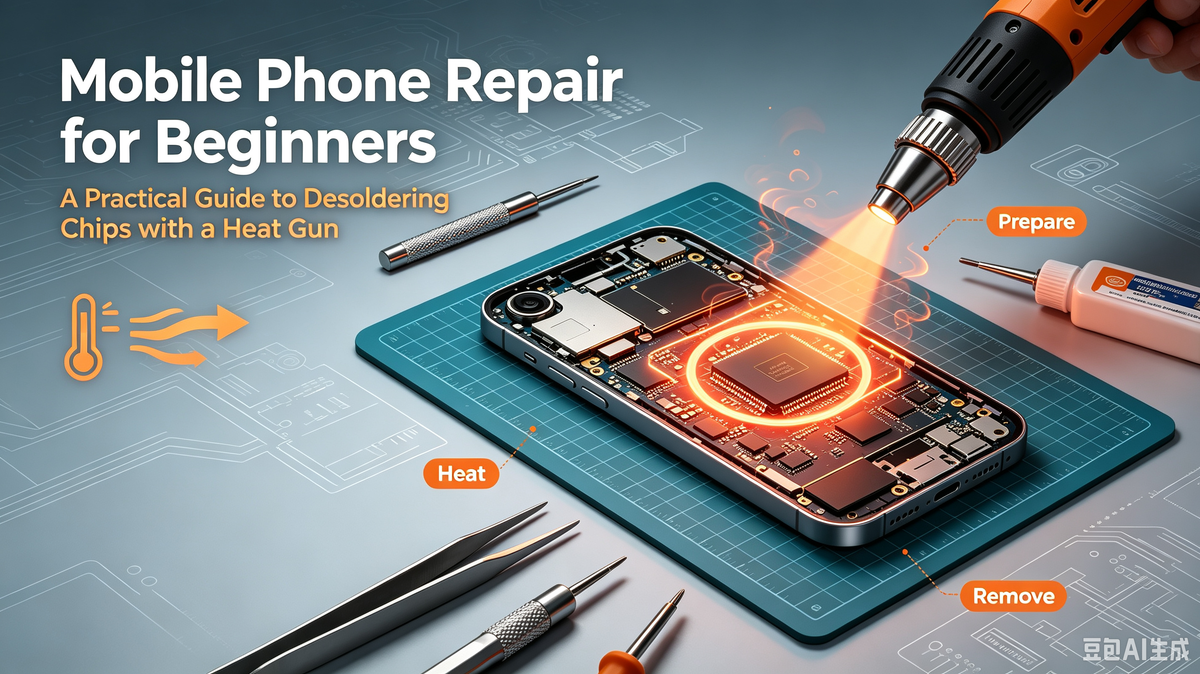
The key principle: match wattage to your workload. If you're running a heat gun for 30+ minutes on large assemblies, 2000W of stable output is necessary. If you're occasionally repairing phone flex cables, a 450W compact heat gun is actually more controllable — too much power in precision work becomes a liability, since heat builds up faster than you can react.
2. Temperature: It's Not About "How Hot" — It's About "How Accurate"
Temperature involves two dimensions: range and control precision.
Temperature Range
Most heat guns offer a range of 50°C to 650°C (120°F to 1200°F). This span covers virtually every application:
-
50–150°C (120–300°F) — Thawing frozen pipes, gentle drying
-
120–200°C (250–390°F) — Heat-shrink tubing (PVC ~90–120°C, PE ~120–150°C)
-
205–290°C (400–550°F) — Softening plastics, bending tubing, loosening adhesives
-
425–510°C (800–950°F) — Loosening soldered joints, freeing rusted bolts
-
520–650°C (970–1200°F) — Paint stripping, industrial heating
A wider range means greater versatility. But what matters more than the maximum is how low it can go and how precisely it holds the middle range.
Mechanical vs. Digital Control
This is the dividing line between a "tool" and a "toy."
Mechanical (dial) control adjusts power output via a knob, indirectly affecting temperature. The markings are rough power levels, not actual temperature readings. Real output temperature drifts with voltage fluctuations and airflow changes. You're setting "approximately hot," not "350°C exactly."
Digital temperature control (with LCD display) uses a sensor to monitor real-time output temperature and a control chip to adjust dynamically. Quality models hold accuracy within ±5°C. That means the temperature you set is the temperature your workpiece actually experiences — critical for precision work.
For heat-shrink tubing, adhesive removal, or paint stripping, mechanical control is fine. For electronic component rework, flex cable repair, or precision plastic forming, digital control is essentially mandatory — a 10–15°C overshoot can destroy an OLED flex cable.
3. Airflow: The Most Underrated Spec of All
Airflow (usually measured in L/min) is the most overlooked — and often the most impactful — spec when choosing a heat gun.
Its job is to transfer heat from the heating element to the workpiece surface. Insufficient airflow causes heat to build up near the nozzle while the material underneath stays cold — the surface scorches before the interior heats through. Excessive airflow without enough wattage to match produces "wind without heat" — extremely inefficient.
Matching Airflow to the Task
Different jobs demand fundamentally different airflow strategies:
| Application | Recommended Airflow | Why |
|---|---|---|
| Electronic component rework | Low | Prevents blowing away nearby tiny components; concentrates heat at the joint |
| Heat-shrink tubing | Medium | Even heating; prevents localized overheating that cracks tubing |
| Paint / adhesive removal | High | Rapid heat transfer to overcome material thermal mass |
| Leather / wood shaping | Low | Gentle heating; prevents surface scorching |
Professional-grade heat guns typically offer two or more airflow settings, while high-end models support stepless variable speed, letting you adjust in real time based on how the material responds.
Airflow Stability
Beyond volume, stability matters just as much. Cheap heat guns often produce pulsating airflow that causes uneven heating. Models with optimized duct design or brushless motors deliver smoother output, significantly reducing the risk of blowing small components off a PCB.
4. How the Three Specs Work Together: A Simple Way to Judge
Power, temperature, and airflow aren't isolated numbers on a spec sheet. Together they determine how efficiently heat transfers to the workpiece.
A practical rule of thumb: Can this heat gun sustain adequate airflow at your target temperature?
Example: For large-diameter heat-shrink tubing (over 10mm), you need not just the right temperature (~120–150°C) but also enough airflow to distribute heat evenly across the entire tube wall. If wattage is insufficient (say, only 800W), cranking up airflow causes temperature to drop — and the tubing shrinks halfway before stalling.
Conversely, for precision electronics, you want a "low-airflow, high-accuracy" gun — wattage doesn't need to be high, but temperature control must be precise and airflow must be gentle and stable.
5. What Else to Look For Beyond the Big Three
Heating Element Material
Common options are mica elements and ceramic elements. Mica is cheaper but has a shorter lifespan — power output degrades faster under sustained high-intensity use. Ceramic elements have lower thermal inertia, heat up faster, and last longer — making them more economical over time.
Safety Features
Overheat protection and a cool-down cycle are baseline features on professional tools. Overheat protection cuts power automatically at abnormal temperatures. A cool-down cycle continues blowing cool air after shutdown to cool the element and nozzle, extending tool life.
Nozzle Accessories
Nozzle shape directly determines airflow distribution. Flat nozzles suit large-area even heating; concentrator nozzles focus heat locally; reflector nozzles work well for pipe thawing. A standard kit with 3–4 common nozzles is a plus.
Ergonomics
Heat guns are handheld tools — weight and center-of-gravity balance directly affect fatigue during extended use. A lightweight gun around 500g suits precision work; a ~700g model balances hand feel and stability well.
Summary
Heat gun selection boils down to one sentence: Define your application first, match the specs second, and prioritize control accuracy last.
-
For occasional heat-shrink tubing or simple adhesive removal: a ~1500W model with mechanical control and basic airflow adjustment is sufficient
-
For electronic components or temperature-sensitive materials: digital temperature control and stable low airflow are the baseline
-
For industrial or continuous-duty use: 2000W+, ceramic heating element, multi-stage airflow is what you need
Don't be fooled by the "max wattage" number. The best heat gun is the one that delivers stable output at the exact temperature and airflow combination you actually use.